Showing posts with label baltimore transit. Show all posts

Wednesday, February 8, 2012

Human Transit Comes to Baltimore

Yesterday, over forty transit planning and urban design professionals and transit advocates were treated to a thought-provoking midday lecture at Metro Gallery on North Charles Street near Penn Station. The presenter was Jarrett Walker, a Portland, Oregon and Australia-based transit planning consultant who writes the popular Human Transit blog. Now he has published a book by the same name and recently started a book tour that includes initial stops in Vancouver, New York, and Washington, DC. It was through the efforts of Henry Kay of MTA, with assistance from the Charles Street Development Corporation, and the Baltimore Streetcar Campaign that Jarrett was able to make a brief stop in Baltimore to speak.

The Human Transit blog has been highlighted as a link in the EnvisionBaltimore blog roll since its inception, because Jarrett Walker's innovative, yet common sense approach to designing what we've been commonly referring to as "popular transit systems," is just the kind of thinking that could have a transformative effect on the transit experience in Baltimore. His ideas also reinforce many of the key concepts that have been promoted through EnvisionBaltimore, particularly since the 20 Minute Neighborhood workshop held at the American Visionary Art Museum in April, 2011.

While I won't provide a full summary Jarrett's lecture, here are some of the key takeaways:
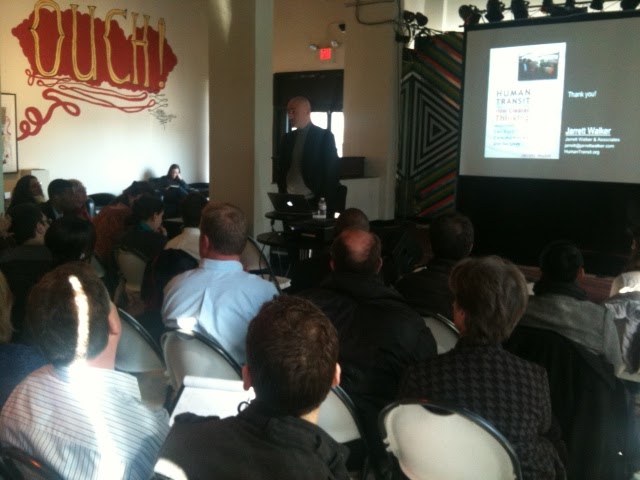
Jarrett Walker speaking at Metro Gallery in Station North
Abundant Accessibility. I didn't write it down, but this is the term I believe Jarrett used to describe the notion that most successful transit systems are those that are designed to be usable by the greatest number of people over an area of greatest concentration of activity, operating at the highest frequency. In reality, most transit systems in the U.S. do not really operate that way today, but there is an opportunity to redesign them so that they do.

Use optimal stop spacing. Transit service can become attractive for greater numbers of people if the stop spacing is increased from a typical "stop-every-block" configuration. This may require a somewhat longer, but still reasonable walk to the transit stop, but allows for more frequent service, shorter waits, and quicker journeys.

Service frequency matters more than speed. Sometimes, the biggest deterrent to using conventional transit is excessive wait time, particularly for buses. Jarrett pointed out that the wait can often be longer than the actual trip itself. A network of higher frequency routes in key corridors where there is density and destinations can result in dramatic growth in ridership.

Make use of the urban grid to create a true network. It's usually better to have a grid of high frequency, direct lines that requires someone to transfer from a north-south line to an east-west line (or vice versa) to get where they are going, rather than low frequency, meandering routes that attempt to connect destinations without transfers. Similarly, Jarrett also commented that routes that these type of meandering routes are typically not integrated with other routes and make it difficult to create a genuine network. He called this "symbolic transit," designed to serve a specialized purpose or market. While he did not make any judgments about Baltimore, I couldn't help but thinking at that moment that nearly all of Baltimore's transit routes (bus and rail) consists of this type of symbolic transit that do not function together as a system nor appeal to a wide demographic.

What's beneath the floor of the transit vehicle really doesn't matter (in many cases). Jarrett placed considerable emphasis on the idea that well designed bus networks, especially those operating in dedicated lanes can often perform just as well or better than rail. However, he did concede that streetcars or other rail technologies are most appropriate when high capacity is needed that go beyond what buses can provide. That said, there was some unchallenged difference of opinion among some streetcar boosters in the audience who would undoubtedly argue that there are factors beyond operating characteristics that favor streetcars for certain applications. This is particularly true of promoting economic development as a recent study about bringing back streetcars to the nation's capital attests.

Transit vehicles should serve as an extension of the pedestrian realm. At the end of his presentation, Jarrett showed an artists rendering of a sleek bus pulled up to a stop on a vibrant street. The bus had very large, clear windows, door, and even roof, and also had a low floor even with the sidewalk. Jarrett pointed out that buses or trams should feel like an extension of the sidewalk rather than climbing into a box. The rider should feel connected to the streetscape and continue to experience the city while on transit. During his talk he also reference the excellent book, My Kind of Transit, to reinforce this point, and to emphasize the importance of transit vehicles that feel open and pleasant, rather than havng dark tinted windows or advertising wraps.

Human Transit is available in hardcover or paperback and can ordered by following this link.

Note: for those who missed Jarrett's talk in Baltimore and want to see him at one of the DC venues he is speaking at on February 9th, I noticed that unfortunately both are sold out unless you previously registered. I am in contact with Jarrett and will alert the EnvisionBaltimore community should he return to our region.

Wednesday, September 14, 2011

The Primary Transit Network: Laying the Groundwork for a "Popular" Transit System in Baltimore

In July, we began discussing what it will take to broaden the appeal of public transit to a much wider market in Baltimore than currently exists, and support a network of walkable, vibrant communities. We laid out fundamental elements which, when combined, would have a transformative effect on how transit is perceived and used:

1. Creation of a Primary Transit Network
2. Effective branding and marketing of transit
3. Dedicated transit lanes and rights of way
4. Robust use of customer information tools


While we're on the subject, let's add a fifth and very important element that was omitted in the original post:

   5. creating transit-supportive land uses and development patterns around transit stops.

For this post, however, we begin to expand on and tackle each of these, one at a time, beginning with 1. Creation of a Primary Transit Network. 

Defining the Primary Transit Network

The idea of developing and applying a Primary Transit Network in Baltimore, in order to make the system more legible and user-friendly, is a new and unique proposal There has been no previous initiative to study or implement this concept in a comprehensive manner. Primary Transit Networks are common throughout Europe and are beginning to catch on in North America. So, what is a Primary Transit Network, and why is it useful? Consider the following information, which comes from the City of Minneapolis' Primary Transit Network Report, completed in 2005:

-------------------------------------------------------------------------------------------------------

The Primary Transit Network (PTN) is a permanent network of all transit lines — regardless of mode or agency — that operates every 15 minutes or better all day for at least 18 hours every day.  The PTN can be defined based on performance criteria for five key dimensions of transit quality as follows:

Frequency.  PTN services run all day at frequencies of 15 minutes or better.  A 15-minute headway
represents the point at which a transit rider no longer needs to consult a schedule to use the service.  It also permits transfers to be made rapidly, even without the timing of transit connections.  The threshold frequency of 15 minutes is the point at which the benefits of transit tend to grow exponentially.
Span.  The PTN runs a minimum 15-minute frequency for at least 18 hours a day, 7 days a week. 
This is important because the PTN must reduce auto dependence, allowing all types of trips to be accommodated on transit, not just commuting.  The service may operate more than 18 hours a day. Reduced frequencies beyond the 18-hour span would not preclude a line from being a PTN service.   
Speed.  PTN services have an average operating speed of no less than 30% of the speed limit. This
operating speed accounts for stops.  Thus, the service transports riders more quickly than most of the conventional transit lines in Minneapolis.   It is important that transit speed not be measured relative to average auto speeds, because if the PTN is stuck in congestion, the total person-capacity of the transportation network will decline.  To increase person capacity, it is critical that average transit travel speeds approach their theoretical maximum speed.  Speed may be the most important single  factor since travelers overwhelming tend to choose the fastest means.
Reliability. Permanence and reliability are anchors of the PTN.  Actual headways between
consecutive buses will exceed scheduled headways by a coefficient of variation not to exceed 0.30. 
Users who know the schedule can expect the PTN services to operate on schedule. 
Loading.  Standing loads are acceptable, but crush loads are not. Improved frequencies may be
required to alleviate crush loads.  Appropriate equipment is used to ensure the comfort of passengers
and the efficiency of PTN services.

Characteristics of a Primary Transit Network 
Based on the operating and performance criteria defined above, a PTN is able to accomplish 
what other transportation modes cannot.  Some of the most beneficial characteristics of a PTN 
include efficiencies and other elements that make it a very attractive means for moving people 
throughout Minneapolis.  As emphasized in the Minneapolis Plan, the city’s economic and social 
vitality are reliant on a comprehensive and balanced transportation system.   At a minimum, a 
PTN should appeal to many rider groups, reduce trips made by automobile, offer highly 
productive service, and require low passenger subsidies.   
------------------------------------------------------------------------------

Currently, Baltimore's public transit system have a number of fixed routes that operate according to some or all of these characteristics, including the Metro Subway, Light Rail, the four MTA "QuickBus" routes and the Charm City Circulator, shown in this map below that we developed for the 20-minute neighborhood workshop.


Yet, these routes are not structured as an integrated or unified system - either operationally, physically, or how they are marketed, branded, or perceived by the general public. This represents an enormous opportunity that, so far, has simply not been leveraged.

Other cities besides Minneapolis are beginning to identify Primary Transit Networks including Calgary, Tampa, Seattle, Spokane, Portland, and Washington DC. This week, Human Transit blog describes Spokane's approach to mapping its PTN, and Greater Greater Washington recently did a post about how WMATA, the transit agency for Washington, DC has recently published their "frequent bus map".
WMATA's New Frequent Bus Map

Next time, we'll explore the 2nd tenet of creating a popular transit system, "Effective Marketing and Branding of Transit."
Related Posts Plugin for WordPress, Blogger...